Showing posts with label Social Studies. Show all posts

Monday, 16 May 2016

                                        Week 6, 7 and 8  

Week 6
- The Rashidite Caliphs 141
- Umayyad State 142
- Abbasid State 142- 148
Week 7 - The Arabs and the Ottoman empire 150-152
- European Colonialism 153-157
Week 8
- Arab struggles with colonization 158-161
- The Palestine cause 162-168

https://sites.google.com/site/socialstudiesfornonarabs/term-3-the-arab-world

                                  Next weeks revision:

With a group (3-4) put together a revision task to review some of the content of this terms unit to prepare for the exam at the end of the term. This could be a Kahoot, nearpod, interactive quiz show, scavenger hunt etc. This should only take an hour or so to prepare but will be invaluable to assist your class mates do well in the exam.


Here is the content (Available on google site). Let Mr Reuben know of the area your group want to focus on so we are not doubling up.

Unit 2: The Arab world
Week One -Location and significance 93- 102
-Natural features 103- 104

Week Two
-Relief 104-106
-Climate 107
-Vegetation and husbandry 108- 110

Week Three -Population conditions 111
- Population 112-114

Week four
- Human activities 115- 120
-Countries of the Arab world 121- 130

Week 5
- Islamic state during the era of the Prophet Mohammad 136-140

Week 6
- The Rashidite Caliphs 141
- Umayyad State 142
- Abbasid State 142- 148

Week 7 - The Arabs and the Ottoman empire 150-152
- European Colonialism 153-157

Week 8
- Arab struggles with colonization 158-161
- The Palestine cause 162-168

Monday, 9 May 2016

The Arab World continued 10/5

Week 5: The Islamic state during the era of the Prophet Mohammad (PBUH)

https://sites.google.com/site/socialstudiesfornonarabs/term-3-the-arab-world

If you are organised, make a start on next weeks content.

Week 6: The Rashidite Caliphs

https://sites.google.com/site/socialstudiesfornonarabs/term-3-the-arab-world


Monday, 18 April 2016

                                                           Tuesday 19 April- Week 2

LF- Learning about the relief, climate and vegetation within the Arab world.

https://sites.google.com/site/socialstudiesfornonarabs/term-3-the-arab-world

Next Tuesday: Revision quiz for week one and two material 

Week One -Location and significance 93- 102
-Natural features 103- 104

Week Two
-Relief 104-106
-Climate 107
-Vegetation and husbandry 108- 110

Wednesday, 13 April 2016

Week One: 14/4

-Location and significance 93- 102
-Natural features 103- 104


https://sites.google.com/site/socialstudiesfornonarabs/term-3-the-arab-world

Arab populations are distributed on 23 different countries, namely: Algeria, Bahrain, Comoros, Djibouti, Egypt, Eritrea, Iraq, Jordan,Kuwait, Lebanon, Libya, Mauritania, Morocco, Oman, Palestine, Qatar, Saudi Arabia, Somalia, Sudan, Syria, Tunisia, United Arab Emirates, and Yemen


Monday, 11 April 2016

                                Social Studies term 3

This is a breakdown of the Social Studies unit from your booklet with a timeline of what weeks we will be covering each topic. Your booklets will be available on Thursday.

Unit 2: The Arab world
Week One -Location and significance 93- 102
-Natural features 103- 104

Week Two
-Relief 104-106
-Climate 107
-Vegetation and husbandry 108- 110

Week Three -Population conditions 111
- Population 112-114

Week four
- Human activities 115- 120
-Countries of the Arab world 121- 130

Unit 3: The history of the Arab World and the gulf pages 133- 134
Week 5
- Islamic state during the era of the Prophet Mohammad 136-140
Week 6
- The Rashidite Caliphs 141
- Umayyad State 142
- Abbasid State 142- 148
Week 7 - The Arabs and the Ottoman empire 150-152
- European Colonialism 153-157
Week 8
- Arab struggles with colonization 158-161
- The Palestine cause 162-168

Week 9 Revision

Monday, 21 March 2016


UNIT:  Own Country Pre World War One
ASSESSMENT TASK:  
Source analysis through an annotated illustration with graded sources and bibliography
TASK INSTRUCTIONS: 
·         Research and select a significant illustration (photograph, magazine article, news article, video footage) from own country from the period 1900-1913
·         Use criteria to annotate the source and grade the source (Grade on a scale of 1-10 for reliability and validity and justify)
·         Record the sources used in a bibliography
·         CONDITIONS OF ASSESSMENT: 
·         Research and annotation of illustration along with grading the sources and bibliography list is done during class time.
·         Extensions will only occur if permission is asked for and granted prior to the submission date

DUE DATE: WEEK 11


Wednesday, 2 March 2016

Final assessment: Annotated Illustration

See task and criteria sheet for final task


https://sites.google.com/site/socialstudiesfornonarabs/my-country-pre-world-war1


This is due on Tuesday 22 March

Monday, 15 February 2016


             Population and statistics analysis: Your country      16/2
1) What is your countries population according to world bank?
2
      2) Make a comment on the growth or decrease from 2013 to 2014. Share some of the factors that you are aware of that may have had an impact here (e.g economic status, employment, war, migration.

3     3)What is your countries latest birth rate (Per 1000 people).  How does this compare with other countries? What may affect the birth rate in your country.

4)      What is your countries current life expectancy at birth rate? Men and women? How does this compare to other countries? Can

5)      What is your countries current unemployment rate for both males and females? Has this shown growth or a decrease over the past ten years? Can you make any comments in regards to this?
6)      What are your countries current CO2 emission (KT) levels? How do they compare with other countries? Does this surprise you?

7)      What is you countries percentage of forest area (% of land area)? Has this shown growth or a decrease in the past ten years? Why may this be a factor for your country in the future?


8)       Can you make any comment on your countries access to electricity percentage??

Monday, 8 February 2016


Assessment 2: Due Week 6 Tuesday 16th February


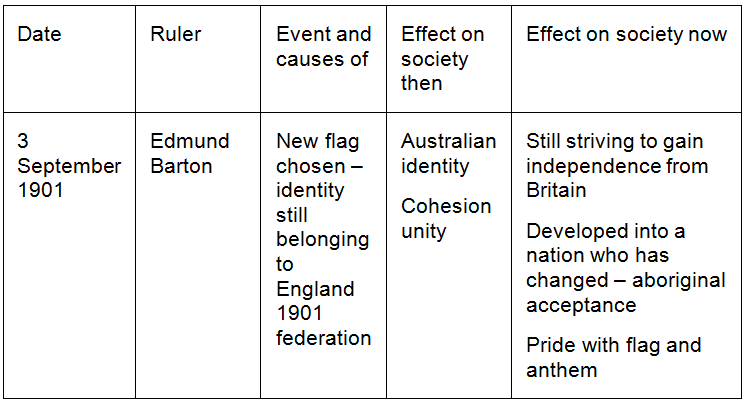
Here is an example of one event on your table: Remember, own country and 5 to 10 events.


                    Statistics task: Your country

http://data.worldbank.org/indicator/SP.POP.TOTL


http://www.worldometers.info/

·    View the population statistics for your country
·    Experiment with graphing feature on the site.
·    Research timeline historic/significant events of country
·    Synthesise information – is there any correlation between events/ advancements in medicine/ migration/immigration/births/deaths/war to explain the population
·    Present a brief report about some interesting statistics you have discovered about your country. You may include graphs if you would like.


Monday, 1 February 2016

       Assessment 2: My country pre world war one 1900-1913

Complete a Ruler Cause and Effect Event Table recording the date which an event occurred and the reasons for this. Students describe the changes it created for society then and the effects of this now


Knowledge and understanding:
·         Rulers, dates and time of events
·         Reasons why the event occurred
·         The changes the event made to society
Skills:
·         Accurate table
·         Identifying the change in history with the effect of this today
·         Terminology

Chose reliable sources to support the reasons stated. Aim to have a minimum of 5 events and a maximum of 10. Here is an example of what the table will look like. You may go into greater detail than this if you want a higher grade.


Please note: This research task is due at the end of week 5 (Thursday 12 February)

It would be preferable that you are researching your own country, but if you don't please make sure the country has some significance to you.

Monday, 25 January 2016

Lesson 1 Week 3- My home country pre WW1


·    Home country between years 1902 – 1913
·    Students research and record 10 significant facts about their country during this time.
  include who was in government during each of these events
·    Organise these facts into a timeline with a picture where possible.
You may share this in a different mode of presentation if you wish..


                                                                                    Example: 

Event one:

1905:   All Blacks tour England

New Zealand have their first tour of England for rugby and become that legacy that is known as the All Blacks. The team were known as the "Originals" and the team defeated England, Scotland and Wales, all three of the matches close encounters. This established their reputation as a team for years to come in the rugby world.

Government:
The liberal part are re elected and formed the 16th New Zealand parliament. Prime Minister at the time was Richard Seddon from the west coast who is regarded as one of New Zealand's greatest political leaders.

Monday, 18 January 2016


Task Sheet Assessment One: MY COUNTRY and it's identity


                                                    Task description:

1) Give examples of symbols e.g flora and fauna that you found relevant to your country.
2) Design a national flag that incorporates the colours and symbols appropriate to own country. 
3) Write a description explaining their choices (See previous example). Explain why your new flag is more suitable than the current one.


Knowledge and understanding:

·         Culture of country and most important elements
·         Geography of country – most important contributions to society
·         Symbols that represent the country – fauna/ flora

Skills:
·         Create an original flag
Written description with explanations aligned to country

Due: Thursday 28th January

                                                                                         Criteria Sheet:


Wednesday, 13 January 2016

Flag Assessment Task- Due Week three Thurs 28 Jan


Your task will be to design a new flag for your home country.

Think about the use of colours/ symbols and designs that will be an appropirate representation for your country.

·   Research students create questions to discover other symbols of home country – e.g. flora and fauna emblems
·   What are historical events that have shaped your country?
·   Commence design of national flag

Part one is two create the new design: A4 size
Part two is to write a summary of the new design and why you have chosen it. Here is an example.


Designer's description

The silver fern: A New Zealand icon for over 160 years, worn proudly by many generations. The fern is an element of indigenous flora representing the growth of our nation. The multiple points of the fern leaf represent Aotearoa’s peaceful multicultural society, a single fern spreading upwards represents that we are all one people growing onward into the future. The bright blue represents our clear atmosphere and the Pacific Ocean, over which all New Zealanders, or their ancestors, crossed to get here. The Southern Cross represents our geographic location in the antipodes. It has been used as a navigational aid for centuries and it helped guide early settlers to our islands.